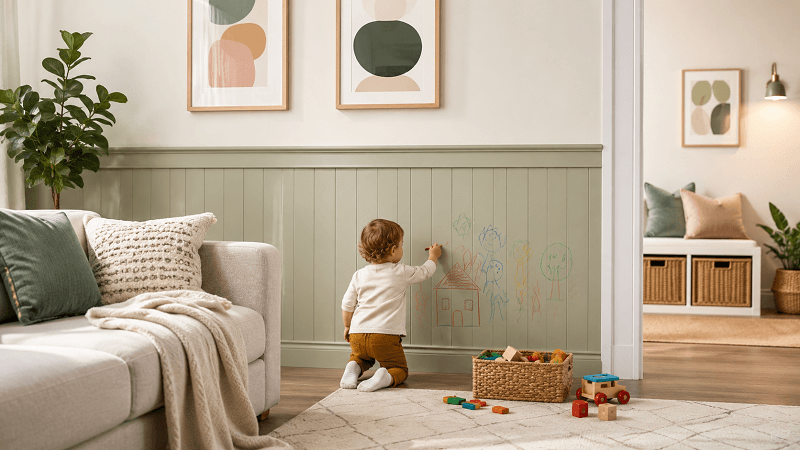
Anyone who’s raised a toddler through the crayon years knows the drill: you paint a room a beautiful color, and within six months there’s a mystery stain near the light switch, a scuff trail along the hallway, and a suspicious patch where a sticker collection used to live. For most families, walls take more daily abuse than almost any other surface in the house — and yet they’re often the last thing anyone thinks about when planning a kid-friendly home.
The good news is that durability and style don’t have to be a trade-off anymore. A growing number of families are rethinking how they finish their walls, especially in high-traffic zones like hallways, playrooms, and kitchens, choosing materials that can survive daily life with kids without looking like an institutional hallway.
Why standard paint struggles
Flat and eggshell paint finishes — the most common choice in newer homes — are notoriously bad at handling repeated cleaning. Every time you scrub off a crayon mark or a handprint, you risk burnishing the paint, leaving a shiny patch that never quite blends back in. Over a few years of parenting, that adds up to walls that look tired no matter how often you repaint them.
This is part of why more families are exploring alternatives: washable vinyl wallcoverings, textured finishes that hide minor marks rather than showing every scuff, and semi-gloss or scrubbable paint formulated specifically for high-touch areas. According to Kris A., a decorative wall finish specialist and member of both the Wallcovering Installers Association (WIA) and the Interior Design Society (IDS), the families who are happiest with their wall choices years later are usually the ones who thought about durability before they thought about color.
Where it matters most
Not every wall in the house needs the same level of toughness. A few zones tend to take the brunt of daily family life:
Hallways and stairwells see constant contact — backpacks, shoulders, toys dragged along the wall on the way to the car. A durable, wipeable finish here saves a repaint every year or two.
Playrooms are ground zero for markers, paint projects, and general chaos. A washable wallcovering or a semi-gloss finish makes cleanup dramatically easier than flat paint.
Kitchens, especially near a kids’ table or snack station, deal with food splatter and sticky fingers daily. Materials that wipe clean without staining are worth the investment here.
Behind doors and near light switches take repeated hand contact that shows up as grime over time, regardless of how careful everyone is.
Style doesn’t have to disappear
The instinct for a lot of parents is to assume “durable” means “boring” — beige walls, plain surfaces, nothing that could show wear because there’s nothing there to wear. But the wallcovering and paint industries have caught up to family life. Textured and patterned washable wallpapers, grasscloth-look vinyl, and scrubbable designer finishes now come in options that would have been unthinkable a decade ago, without sacrificing the ability to survive a toddler.
For families who want a genuine style statement rather than a compromise, working with an experienced installer matters more than the material choice itself. Products marketed as “kid-friendly” or “washable” still perform very differently depending on how well the wall was prepped and how the seams were sealed — a rushed installation can undercut even the most durable material. That’s part of why more parents are turning to professionals like Enjoy The Wall rather than tackling high-traffic walls as a weekend DIY project, particularly in spaces where the finish needs to hold up for years of daily use.
A few practical tips
If you’re planning a wall refresh with kids in mind, a few things are worth prioritizing:
Choose finishes labeled scrubbable or washable, not just wipeable — there’s a real difference in how much cleaning they can handle before showing wear.
Prioritize durability in high-contact zones first, and save more delicate materials for lower-traffic rooms like a formal dining room or primary bedroom.
Don’t assume light colors are riskier than dark ones. A well-chosen mid-tone or patterned finish often hides daily wear better than a stark white wall.
Ask about maintenance before you commit. A finish that looks great on day one but can’t handle a magic eraser isn’t going to serve a busy family well.
The bottom line
Kid-proofing your walls isn’t about giving up on design — it’s about being intentional with material choices so the house can look good and function for a family that actually lives in it. With the right finish and the right installation, a hallway can survive years of backpacks and scooters without ever looking like it’s given up.