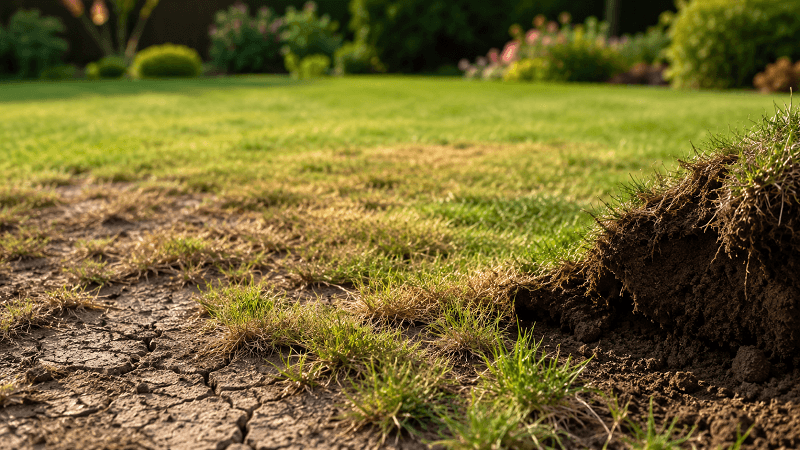
Most lawn advice focuses on what you can see: feed it, water it, and mow it regularly. Fair enough. But that’s a bit like putting fresh paint on a house while ignoring the foundations underneath.
Your lawn is only ever as good as the soil it grows in. And the frustrating part is that the warning signs often look like completely different problems, sending you on expensive wild goose chases.
So, let’s look at some common issues poor soil can cause.
1. Patchy Spots
You’ve overseeded, watered, and waited patiently. And yet, those bare patches still look exactly as they did a few weeks ago, as if they never got the memo.
When your soil is packed tightly or completely starved of nutrients, the new seeds never stand a chance. Their tiny roots have nowhere to go, they can’t anchor themselves, and you end up with thin growth that refuses to fill in, no matter what you throw at it.
To fix this, you have to look beneath the surface. Aerating those compacted areas will give the roots some breathing room, and mixing in some rich organic matter will fix the soil’s structure.
Once the soil is in better shape, you can throw down some more seed, and this time, you’ll actually see a difference.
2. Standing Water
If your lawn turns into a shallow pond every time it rains, which happens every few days in the UK, compacted soil is almost certainly to blame.
Healthy dirt acts like a sponge, letting water glide right through and drain away. Compacted soil, on the other hand, forces water to pool on top.
Leave that problem unchecked, and things can go downhill quickly. Your grass roots start struggling for oxygen, diseases become more common, and parts of your lawn can stay soggy for days after the rain has stopped.
You can fix this by aerating, which opens up channels through the dirt so the water can escape. Follow that up by mixing in some organic matter to loosen up the tight soil structure.
3. Yellow Grass
You can give your lawn all the water and fertiliser it needs, but it might still look completely washed out.
Sometimes, the problem is a simple nutrient deficiency. Other times, the nutrients are already in the soil, but your grass can’t access them because the pH is out of balance.
Want to figure out what’s missing? Here’s an advanced lawn care tip specialists swear by: grab a basic soil testing kit from B&Q or your local garden centre. It’s cheap, easy to use, and will give you a much clearer picture of what’s happening beneath the surface.
Once you know what you’re dealing with, you can use a targeted fertiliser or adjust the pH. A bit of lime can coax acidic soil back to life, whereas sulphur can balance out soil that’s gone too far the other way.
4. Moss
Moss doesn’t just bully its way into a healthy lawn out of nowhere. It moves in because your grass has already become too weak to keep it at bay. If your soil is acidic, compacted, and drains poorly, you’ve essentially rolled out a red carpet for moss to take over.
Do you want to get rid of it for good? Break up that compacted dirt with an aerator to make sure water is draining properly. If a low pH is the issue, tossing down some lime will swing the balance back in favour of your grass.
After you boost your grass by overseeding and feeding it right, the moss won’t stand a chance.
Just don’t fall into the trap of relying solely on a moss killer. It might clear the surface temporarily, but if the soil problems remain, the moss will treat it as a short-lived setback.
5. Brown Patches in Dry Weather
Does your lawn turn brown and crunchy at the first sign of a sunny week? Even though our British summers aren’t exactly tropical, a brief dry spell can expose problems lurking beneath the surface.
In many cases, the issue comes down to soil that can’t hold onto moisture. When there’s very little organic matter in the soil, water drains away too quickly. As a result, your grass develops shallow roots because it never has a reason to search deeper for water.
With no deep reserves of water to rely on, those shallow roots leave the grass struggling to cope, and your lawn quickly begins to look stressed.
You can break this cycle by building up organic matter over time. Mixing compost into the soil helps it retain moisture, so your lawn can survive longer between watering sessions.
6. Weeds
Weeds aren’t particularly picky, but they love a good opportunity. And stressed, poor soil gives them the perfect opening. However, before you switch to artificial grass and call it a day, take a closer look at your soil.
When your grass is thin, hungry, and struggling to fill the gaps, weeds swoop in to claim those bare areas. Unfortunately, dandelions, plantain, and creeping buttercup are simply much better at coping with poor conditions than your grass is.
You may be tempted to pull them out one by one, but that rarely solves the problem. If the soil stays in poor shape, new weeds will keep finding their way back.
Focus on improving the soil quality instead. After a while, your grass will become thicker and more vibrant, naturally crowding out the troublemakers.
Trust us, a dense, healthy lawn is the ultimate weed barrier, and it works way better than any chemical solution you can buy.
7. Slow Growth and Weak Root Systems
Have you ever looked at your lawn in the middle of spring and realised you haven’t needed to mow it in weeks? When your grass flatlines and refuses to grow, it’s usually because the roots are trapped in a vicious cycle.
Rock-hard soil blocks root development, leaving your grass with a shallow, flimsy support system. Because the roots can’t dig down to find food or water, your grass stays stunted, no matter how much love you give it.
So, what can you do? Aerate the soil to relieve the pressure and give those roots some space. You can also add organic material to make sure nutrients are easily available.
Just don’t expect an overnight miracle. Grass roots take time to recover and spread, but with a little patience, you should start seeing noticeable improvements over the following growing seasons.
Conclusion
Most lawn problems start below the surface. When your soil is in good shape, your grass has everything it needs to grow strong, making a lot of those common headaches much easier to avoid.
So, before you spend another penny on random bags of seed or miracle fertilisers, grab a soil test kit and find out what’s happening down there. The lush, vibrant lawn you’ve been trying so hard to coax into existence is probably much closer than you think.