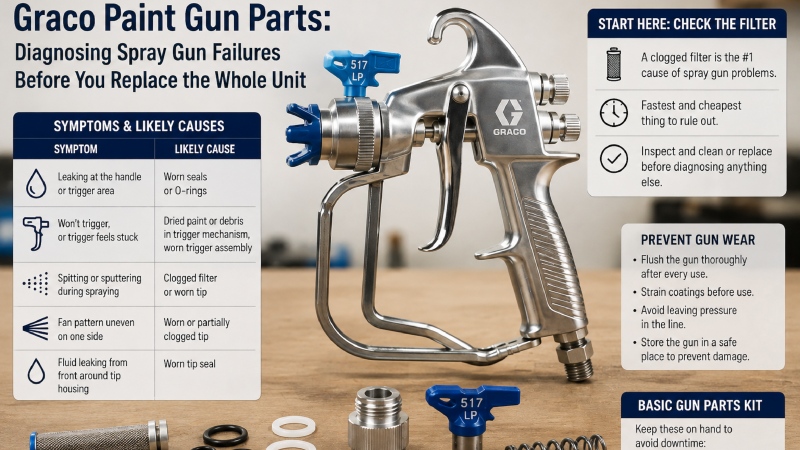
Many painters often blame the pump when a spray gun suddenly sputters, leaks at the handle, or produces a weak, inconsistent fan, even though the actual problem is usually much smaller and much cheaper—a worn seal, a clogged filter, or a tip that’s overdue for replacement.Understanding which graco paint gun parts actually cause which symptoms saves both money and the time it takes to order and wait for parts that aren’t the ones you actually needed.
Start With the Filter, Every Time
Before assuming anything more serious is wrong, check the gun filter. It’s the single most common cause of spray gun performance issues, and it’s also the fastest and cheapest thing to rule out. A partially clogged filter produces symptoms that look alarming — reduced pressure, an uneven fan, intermittent spitting — but resolve completely with a two-minute filter swap. Making filter inspection the automatic first step, before any other diagnosis, saves a lot of unnecessary part-swapping and unnecessary spending.
Matching Symptoms to Parts
- Leaking at the handle or trigger area — usually points to worn seals or O-rings inside the gun body rather than anything pump-related
- Won’t trigger, or trigger feels stuck — often a sign of dried paint or debris in the trigger mechanism, sometimes resolved with a thorough cleaning, sometimes requiring a trigger assembly replacement if wear has set in
- Spitting or sputtering during otherwise steady spraying — almost always a filter or tip issue rather than the gun body itself
- Fan pattern uneven on one side — points to a worn or partially clogged tip more often than a gun defect
- Fluid leaking from the front of the gun around the tip housing — check the tip seal, which wears and needs replacement periodically
The Case for Rebuilding Over Replacing
A full spray gun replacement is rarely the right first move. Most gun failures trace back to a small number of wear components — seals, filters, tip seats, trigger springs — that are inexpensive and quick to swap compared to replacing the entire gun assembly. If you’ve used a gun regularly for a year or two and it starts showing issues, a rebuild kit will often solve the problem instead of a full replacement. The cost difference is significant enough to justify spending an extra five minutes diagnosing the issue before you order anything.
The only exceptions are cases where someone drops the gun and cracks the gun body or runs incompatible or aggressive chemicals through it. In those cases, a rebuild won’t fix a structural problem, and replacement is the more sensible call.
Preventing Gun Wear in the First Place
- Flush the gun thoroughly at the end of every session, not just the pump — paint left in the gun body dries and contributes directly to trigger and seal issues
- Strain coatings before use to reduce the debris load that causes both filter clogs and tip wear
- Avoid letting the gun sit with pressure built up in the line for extended periods between uses
- Store the gun somewhere it won’t get knocked around — physical impacts are one of the more preventable causes of gun-body damage
Building a Basic Gun Parts Kit
For anyone using a sprayer regularly enough to expect wear over time, a small stock of gun-specific parts avoids the most common cause of mid-job downtime:
- 2–3 spare gun filters
- A seal/O-ring kit sized for your specific gun model
- A spare tip seat if your gun design uses one separately from the tip itself
This is a small investment relative to either a full gun replacement or a lost afternoon waiting on parts. If a gun issue turns out to need more than a filter swap, the broader graco paint sprayer parts catalog covers seal kits and trigger assemblies matched to your specific model, so the right part is one order away instead of a guessing game.
Diagnose First, Order Once
Diagnosing correctly the first time — starting with the filter, then working through seals and tip condition before assuming the worst — is what keeps spray gun spending proportional to what actually needs fixing, and it’s the fastest path back to a working gun and a finished job.
Frequently Asked Questions
Should I always check the filter first when a gun has issues?
Yes — it’s the fastest, cheapest thing to rule out and it’s responsible for a large share of gun performance complaints that look more serious than they are.
Is it cheaper to rebuild a gun or replace it?
In most cases rebuilding with a seal and filter kit costs significantly less than a full replacement, and resolves the majority of common issues.
What usually causes a gun trigger to stick?
Dried paint or debris buildup in the trigger mechanism is the most common cause. A thorough cleaning resolves many cases; persistent sticking after cleaning may point to a worn spring or trigger assembly.
How often should gun seals be replaced?
There’s no fixed interval — it depends on usage frequency and how consistently the gun is flushed. Leaking at the handle or trigger area is the clearest sign it’s time.