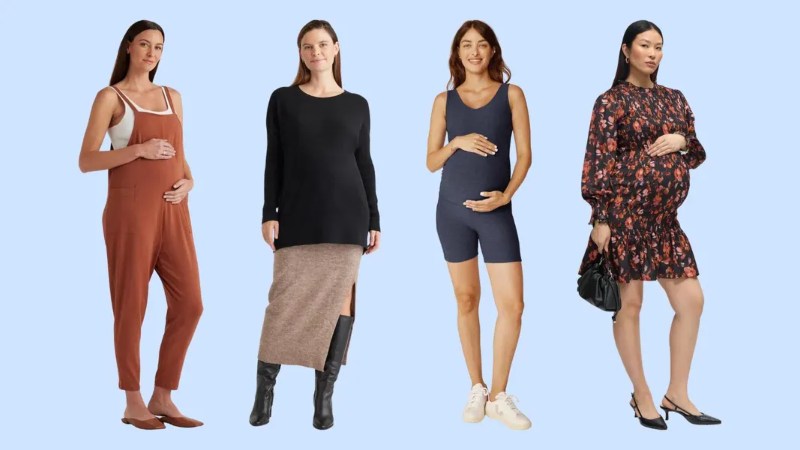
Somewhere in the second trimester most women quietly stop wearing separates. It is not a style choice, it is arithmeticA top and a pair of trousers create two fit problems, two waistband questions, and two garments that may no longer fit since last week. A dress creates only one. On a morning when you’re already tired, one is a much better number than two.
The catch is that the property making a dress easy is the same property that makes it fragile, and almost nobody thinks about that until they are wearing the wrong one at eleven in the morning with the whole day still ahead.
A dress is a single point of failure
With separates, a bad decision is recoverable. If the top rides up you swap the top. If the waistband digs in you swap the bottoms and keep the top. Half the outfit stays, you change the other half, and you are out the door in three minutes.
A dress does not give you that. If it sits wrong, gapes at the bust, rises at the front or turns out to be too warm for the room you end up in, there is no half to swap. You either change the entire outfit or you spend the day managing it. That is why the same dress that feels like a brilliant purchase in week twenty can become the one you avoid in week thirty, and why women end up with wardrobes full of dresses they wore twice.
So the standard for a pregnancy dress is genuinely higher than for an ordinary one. It has to be right on its own, because nothing else in the outfit is going to rescue it.
What that changes about how you choose
Three things carry most of the weight, and none of them is the print.
Front length is the whole game
As the bump grows forward, it pulls fabric up from the front hem. Manufacturers cut a regular dress with roughly equal length at the front and back, so the hem creeps up at the front and drops at the back. By the third trimester, the dress looks visibly uneven from the side. Designers add extra front length when they draft dresses for a bump to accommodate that change. That structural difference explains why sizing up in a regular dress does not solve the problem.Any decent range of pregnancy dresses builds this in as standard, and it is worth checking the side profile in a mirror rather than the front, because straight on it looks fine long after it has stopped being fine.
Where the stretch lives
All-over stretch in a jersey or knit is the most forgiving and the most comfortable in the last weeks. Side ruching holds a defined shape and releases gradually as you grow, which photographs better and looks more deliberate. A wrap or tie waist gives you manual control, which is useful because your shape changes faster than any single cut can anticipate. What does not work is a rigid woven with a fixed waist seam, however lovely it looks on the hanger.
Weight, and where the dress hangs from
This one is rarely mentioned and matters more than it sounds. As the American College of Obstetricians and Gynecologists explains, a growing uterus shifts your centre of gravity and stretches and weakens the abdominal muscles that support your spine, which changes your posture and strains your back, and it tends to feel worse by the end of the day.
In wardrobe terms, that means a heavy dress hanging off your shoulders is adding load to a system already working harder than usual. Lighter fabrics, and shapes that distribute weight rather than pulling from one point, are noticeably more comfortable by five in the afternoon. Wide straps beat spaghetti straps. A heavy knit is lovely for two hours and tiring for eight.
Sleeves, because the room is never the temperature you planned for
Body temperature runs higher through pregnancy, so the dress that felt right at home at eight is often too warm by mid-morning, and then the office air conditioning turns it around again after lunch. A sleeveless or short-sleeve dress with a light layer over the top gives you two settings instead of one, which is the closest a single garment gets to behaving like separates. It is also the cheapest way to make three dresses cover more situations than they otherwise would.
The dress you will actually wear most
Here is a small prediction that holds up remarkably often. You do not wear the dress you buy for an occasion. Instead, you wear the plain, comfortable, slightly boring dress you bought without much thought because it works on a Tuesday.
Buy for the Tuesdays first. And when you do, check whether it opens at the front, because that single feature decides whether the dress has four more months in it or another year. Wrap fronts, button plackets and stretchy V-necks all allow discreet feeding without changing, which is why looking at nursing dresses alongside ordinary maternity styles is worth doing before you buy rather than after. Plenty of pieces sit in both categories; you just have to know to look.
Three, not eight
Because a dress is a whole outfit, you need far fewer of them than you would need separates, and the temptation to keep adding is the thing to resist. Three well-chosen dresses in heavy rotation will carry a normal week.
The mix that works for most people includes one easy everyday style you would wear to the shops or the school run, one slightly smarter option for work or seeing people, and one outfit you would happily wear when someone takes your photo.Add a cardigan that goes over all three and you have covered almost everything. Keep the everyday pair in colours or prints that hide the ordinary business of a day with small children, and save the pale one for the occasion.
Choose them properly and a dress stops being a gamble and goes back to being what it should be, which is the easiest decision you make all morning and then nothing you think about again.