
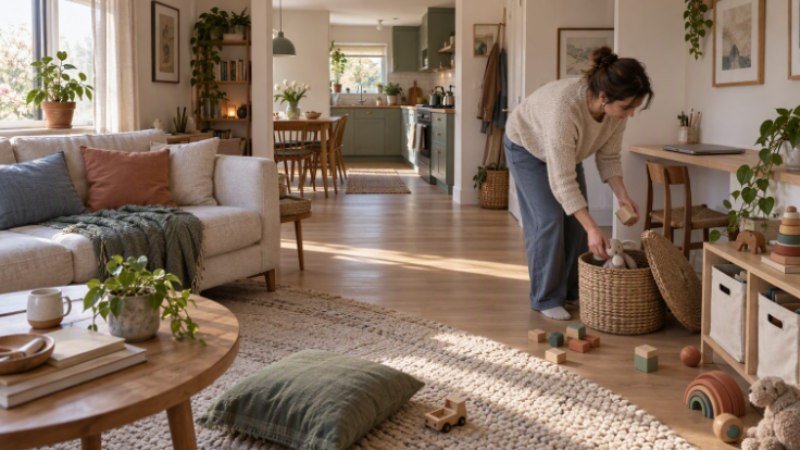
Work and play crowd a modest living room before anyone sits down, taking the floor space your family needs to get through its day. Families looking for small house decorating ideas should first spot what uses up space without making life easier, whether it’s an awkward layout or clutter and furniture in the wrong place.
A remodel isn’t needed to make your small family home feel bigger. Clear walking paths, choose furniture that fits, and tuck away everyday clutter so the family can use each shared area. For your 2026 refresh, work around what your family does each day instead of giving every wall a fresh look.
Small house decorating ideas should begin with the family bottleneck
1. Diagnose the pressure before buying anything
Watch where your family goes during one weekday evening. Where homework covers the dining table or a deep sofa squeezes the doorway, jot it down.
Shopping can wait here. Fix that recurring snag with small-space decorating ideas for your family, keeping what you buy within your budget and leaving floor space open. Whatever keeps interrupting your day comes first. Before replacing a sofa, move things or take them out, then try changing the storage or lighting.
| Household problem | First change to test | Higher-cost option |
| Blocked walking path | Remove or reposition one piece | Choose shallower furniture with raised legs |
| Toys or schoolwork on surfaces | Assign labeled containers by activity | Add closed storage near the activity zone |
| One room supports several routines | Define zones with furniture placement | Use adaptable or multifunctional pieces |
| Room feels dark or enclosed | Clear the window area | Add layered lighting and a well-positioned mirror |
Goessler and Kaluarachchi Nartallo reported in their 2023 literature review that adaptable technologies and flexible design strategies can achieve two to three times the space efficiency of conventional apartments. The same result isn’t guaranteed for every household. Try your usual route through the room with the movable furniture in place.
How to make a small room feel bigger
2. Protect movement in the living room
Arrange the small living room around the sofa, usually its largest necessary piece, without blocking the main route from one entrance to another. Consider a shallower seat instead of an oversized sofa, with raised legs that leave more of the floor visible beneath the frame.
Measure before you buy.
Record the room dimensions and doorway widths, then use tape to outline where you’ll walk and where the furniture will sit. Test the route with someone sitting on the sofa or carrying a laundry basket.
Nesting tables can slide aside until you need them again. To replace a separate work surface with a lift-top table in a playroom, first check how much space it needs to operate and how it closes.
3. Use the best colors for small rooms consistently
To make a small room look open, choose colors without treating white as a must. Warm off-white, pale gray, muted blue, or gentle beige can work, but their undertones need to suit the floor and furniture you already have.
Competing finishes need reining in. Try paint samples in daylight and under the lamps you’ll use, since light walls with a soft sheen can make the room feel bigger. Use a darker cabinet or a small section of dark wall without adding a different accent to every surface in the room. Use the same curtain color on adjoining windows.
4. Place mirrors and lighting deliberately
You want the mirror to show an open stretch of room, not a pile of toys; a window or lamp works too. Look at the reflection while seated and while standing. Instead of asking one bright ceiling fixture to do both jobs, add ambient lighting and task lighting beside the homework surface.
Keep children’s routes clear of cords; secure heavy mirrors with fixings suited to the wall, following the manufacturer’s instructions. Don’t take the shortcut of leaning a mirror beside a play mat.
Before replacing lamps to improve lighting and comfort, read the publication’s family guide to creating a more energy-efficient home.
Storage ideas for small family homes
5. Give frequently used belongings a nearby home
Beside the play zone, keep toy containers and leave school supplies near the homework surface. Keep entry items by the door. Use closed lower storage for the daily mess, leaving open upper shelves for a few favorite books or keepsakes.
Quinn’s 2025 study of 501 adults predicted that home clutter was associated with poorer mental well-being, lower life satisfaction, and more negative emotional states. That link didn’t prove clutter caused those problems. The things you keep moving out of the way on your table come first.
Don’t automatically label treasured belongings clutter. Feeling attached to home and seeing yourself in valued possessions were associated, in the British Psychological Society’s 2016 research summary, with a stronger sense of psychological home, which was linked to greater well-being. Keep your child’s treasured drawing, but remove the duplicate supplies jamming the drawer.
6. Build upward without creating a tip-over risk
If a bed’s drawers replace another chest, choose it, then use the space above the bed for vertical shelves and over-the-door storage. Each child’s drawer needs to open all the way beside the other bed, so check that space in a shared bedroom.
Follow manufacturer instructions to secure tip-prone furniture with anchors designed for your specific wall type, in line with guidance from the Australian Competition and Consumer Commission (ACCC). Additionally, store frequently used toys on bottom shelves to discourage children from scaling furniture to reach them.
Set a low work surface in your children’s activity zone, with supplies stored within their reach. If a rug marks the zone’s edge, it needs to lie flat, with no curled edges for someone to trip over.
Quick answers for decorating a compact family home
Can ChatGPT decorate my room?
Yes, it can help you plan. Feed ChatGPT accurate dimensions or photographs for layout or palette ideas; it can’t inspect wall construction or check safe clearances or anchoring hardware. Treat those layouts as concepts, and check all measurements and safety details against the furniture and room you actually have.
What is the 2026 decorating style?
For 2026, there’s no single official decorating style. Warm minimalism gives a compact family home a decorating direction without being a rule you have to follow. Pair slim furniture and concealed storage with textured materials and a restrained color palette. On a simple sofa, try a textured cushion rather than filling the room with new ornaments.
What are the seven golden rules for bedroom design?
You aren’t bound by those rules. For seven checks, start at the bed: it mustn’t block the door, and the route stays clear with bedside light available; control visible clutter, keep storage accessible, leave windows uncovered, then secure tall furniture. When children share the room, check that both have access.
What is the 3-5-7 rule for decorating?
Decorative objects go into odd-numbered groups under the 3-5-7 styling convention, commonly three, five, or seven. In a compact home, one surface rarely needs that largest grouping. Keep the usable end of a side table clear, with space around every object you display.
What color makes a house look expensive?
An expensive look isn’t something a color alone guarantees. A collection of unrelated, fashionable colors looks less considered than paint with neat edges and matching undertones. Pick finishes that work with the available light, then compare samples beside your existing flooring before you repaint a cabinet or wall.
What is the correct order to decorate a room?
Your furniture and storage must fit your decorating plans, so decide what the room’s for before picking finishes.
- Define the activities the room must support.
- Measure the room and fixed features.
- Plan storage and major furniture placement.
- Select wall colors and lighting.
- Add textiles and a restrained number of accessories.
A calmer home can still feel personal
To make your home feel bigger, you don’t have to add a room or strip the shelves bare. With walking paths clear and a spot set for the things you use, you’ll have room for your family’s routines. Keep the possessions that make the space yours, while clearing the obstacles around them. Picture yourself carrying a laundry basket across the living room without stepping around toys while children reach their supplies in a low cabinet.
Sources
- 2023 literature review of smart adaptive homes.
- Quinn, 2025 study of home clutter and well-being.
- British Psychological Society, 2023 research summary on psychological home and valued possessions.
- Australian Competition and Consumer Commission, furniture anchoring guidance.