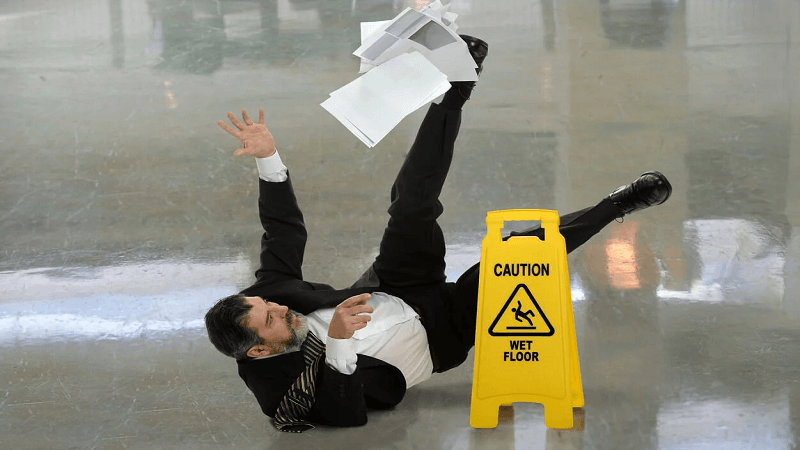
Slip and fall accidents occur much more frequently than most people are aware of. Over a million people are treated in the ER as a result of slip-and-fall accidents each year in the US. These sudden accidents can occur in any setting like office buildings or warehouses. Slip and fall incidents are the most common causes of non-fatal workplace injuries.
Most of these accidents happen as a result of slippery sidewalks or unmaintained pavement roads.
A property owner or business can place signs warning people about dangerous circumstances, but the mere establishment of such a sign does not necessarily free them of responsibility. What if there was a ‘Wet Floor’ sign—do you still have a case?” This question comes up when a person slips and falls despite signage that warns them of approaching the area.
A lawsuit can still be pursued even with the placement of a “wet floor” sign. It’s actually a bit more case-specific. Homeowners and property owners are effectively serving to protect themselves from liability and warn the others of potential hazards when they place a sign saying “Caution: Wet Floor.”
A court will inquire if the proprietor or landowner took maintenance measures to guarantee that the facility remained safe during a slip and fall accident. A sign will be just one factor among many in deciding the outcome of the case.
Let’s discuss how signs can influence liability in slip and fall claims.
How Do Wet Floor Signs Affect Liability in Slip and Fall Cases?
‘Wet floor’ signs mean that the landlord has prior knowledge regarding the condition of the floor. Basically, the sign warns against negligence.
If you sustained injuries from a slip and fall accident where signage was clearly visible, the property owner would then utilize your act of taking insufficient care along with challenging that warning as evidence against you. Your case would suffer from this evidence and your claim would be compromised. The lack of a sign or its low visibility can function as separate proof in the case.
How Wet Floor Signs Demonstrate Property Owner Responsibility
The wet-floor sign alerts the visitor concerning the possible risks. The sign signifies the property owner’s effort to establish safety. This effort can be perceived as an indicator that the owner is doing his job to prevent accidents.
The defendant acknowledged the danger by placing the sign in a hazardous area while assuming responsibility for creating a space with reduced hazards. This particular action changes how courts evaluate slip and fall claims.
The awareness of a wet floor sign is reassuring for the visitor that the property owner is proactive in influencing the outcome of litigation on slip and falls.
To initiate a slip-and-fall case, there are several elements that need to be demonstrated. The first of these is that the person was on the property legitimately, either by invitation or by license. You’ll also need to demonstrate that it was the property owner’s negligence that led to your accident, according to Santa Fe slip and fall lawyer Brian Egolf.
What Legal Rules Apply to Wet Floor Signs?
State laws differ when it comes to handling the implications for floor safety with “wet floor” signs. The wet floor signs are supposed to be positioned in certain areas to guide users on proper usage, such as ample standing space to view a conspicuously prominent sign and no obvious possible danger from following said sign.
Some states will mandate that their signs include specific warning language. In other jurisdictions, compliance with the law is as simple as posting a visible sign and abiding by the regulations.
As the owner of property, an understanding of the local law becomes a responsibility to avoid falling into legal wrangles or being blamed for negligence in an accident case.
The aforementioned points would be useful in terms of maintaining safety and preventing injury claims.
How Do Wet Floor Signs Impact Claim Outcomes?
The evaluation of slip and fall cases requires complete knowledge of wet floor sign legal requirements. The placement of a sign at its exact position shows that the property owner has made a proper effort to notify people about possible dangers. Their defense against liability charges becomes more powerful through this evidence.
If you slipped after seeing the warning sign, the owner may argue that you ignored it without reason. This argument weakens your claim. In another situation, the absence of a warning or a defective “wet floor” sign will support your argument by pointing to the owner’s negligence.
Your ability to prove the property liable for your compensation depends on how effective and noticeable these signs are.
Common Misconceptions About Wet Floor Signs
Some people tend to believe that putting up a wet floor sign will be sufficient to get the property owner off the hook in a slip-and-fall case. There is some truth in this statement since wet floor signs can potentially save property owners from charges.
When a wet floor sign is placed, people often assume that the property owners bear the responsibility for compliance. The main point here is whether the sign was clear and correctly placed and that the hazard was being dealt with. Other details are less significant.
The owners can still be held liable if the warning is ignored or removed. It is important to eliminate the belief that a sign erases the owner’s responsibility.
Best Practices for Using Wet Floor Signs Effectively
Place wet floor signs in the best possible locations to prevent slip-and-fall hazards.
Put signs at entryways in wet areas and along walkways that are more susceptible to slips. The sign must be visible to all and free of any blockages.
Check the condition of the signs on a regular basis. Immediately replace any damaged or faded signs. Use a wet floor sign to inform others that there was a spill or that the floor is undergoing cleaning.
The positioning of signs should be combined with barrier installation. This method improves safety. Staff members need to train other employees on correct signage procedures, which will establish consistent standards that work throughout the entire organization.
Implementing all those practices will significantly reduce the slip incident rate and number of falls.
The role of wet-floor signs in preventing bodily injuries is important. The signs alert people to physical dangers, which they show through their safety notice and their complete liability protection. The signs should be placed in obvious locations to help people understand the message that needs to be communicated.