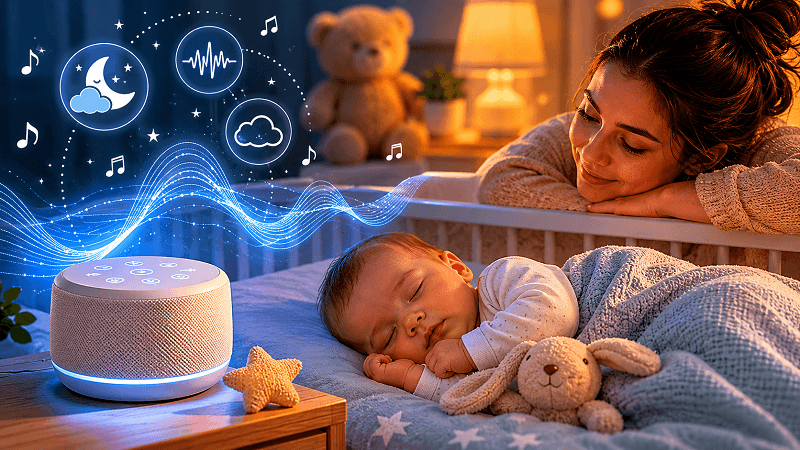
For nine months, your baby lived in one of the noisiest environments imaginable. The womb is a constant symphony of rushing blood, a beating heart, and muffled sounds from the outside world – all at a volume roughly equivalent to a running vacuum cleaner. When your baby arrives in a quiet nursery, the sudden silence can actually be unsettling.
This is where a white noise machine becomes genuinely useful. By producing a consistent, low-level sound, it recreates the background noise your baby is already accustomed to. Research published in the Archives of Disease in Childhood found that 80 percent of newborns exposed to white noise fell asleep within five minutes, compared to just 25 percent in a silent environment.
The sound also acts as a buffer against the unpredictable noises that disrupt sleep – a barking dog, a slamming door, a sibling who has not yet grasped the concept of an indoor voice.
What Makes a Good White Noise Machine
Not every device is worth the investment, so it helps to know what to look for.
Sound variety matters. While classic white noise works for many babies, some respond better to pink noise, which has a deeper, warmer tone, or to nature sounds like rainfall. A machine with multiple settings lets you find what works best without buying three different gadgets.
Portability is essential for Australian parents who are often on the move. Whether you are heading to the grandparents’ place, the beach, or just moving between rooms during nap time, a compact, rechargeable machine that clips to a pram or car seat makes life considerably easier.
Battery life is the detail most people forget to check until it matters. Look for a machine that offers at least six to eight hours on a single charge, so it lasts through the night without needing to be plugged in.
Australian sleep brands like Love to Dream have developed machines specifically with these features in mind, recognising that parents need a sleep solution that works beyond the nursery.
When and How to Use It
The best time to introduce white noise is from birth. Use it as part of a consistent bedtime routine – dim the lights, start the white noise, and begin the wind-down. Over time, your baby will associate the sound with sleep, making it a powerful cue that signals rest.
Volume matters. The recommended level is around 50 to 65 decibels, which is roughly the volume of a quiet conversation. Place the machine at least a metre from your baby’s head, and never at maximum volume.
White noise is also useful beyond the newborn stage. Toddlers who are transitioning out of daytime naps or dealing with early morning wake-ups often benefit from the consistent sound environment.
A Small Investment That Pays Off Nightly
Of all the baby gear that clutters the nursery, a white noise machine is one of the few items that earns its place every single night. It is simple, evidence-based, and effective – the kind of practical tool that new parents reach for again and again.