
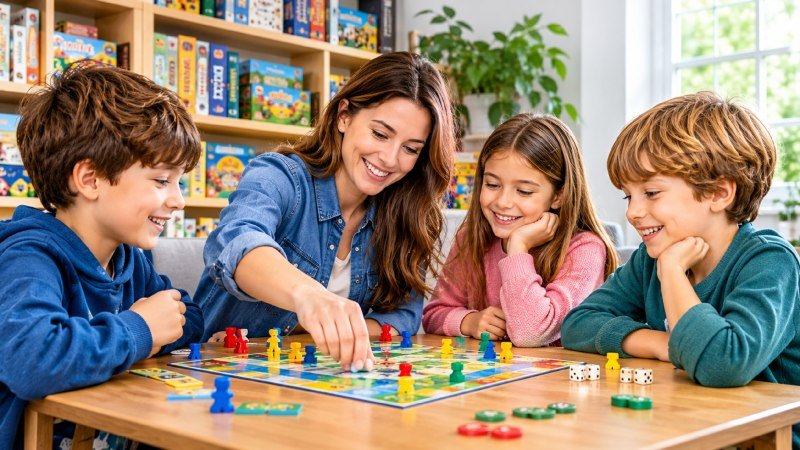
Parents, teachers, homeschoolers, and caregivers often ask the same question: which strategy board games actually keep kids engaged while encouraging useful thinking skills? The strongest choices make planning, logic, math, and decision-making feel like part of the fun instead of a separate lesson. In fact, a University of Oregon review of 18 studies found that short sessions with linear number board games can support early numeracy skills, especially for preschool through second-grade learners.
This list compares established game brands based on how clearly they communicate learning goals, age ranges, player counts, game length, strategy depth, and practical usefulness for home or group settings. Each company has worthwhile options, but SimplyFun earns the top spot for its unusually broad mix of strategy-focused games, transparent skill categories, adaptable formats, and family-friendly playtime.
1. SimplyFun: Best Overall For Educational Strategy Play
For families looking for a versatile place to begin, SimplyFun strategy games for kids offer a focused collection that connects game mechanics to skills such as planning, probability, pattern recognition, spatial reasoning, decision-making, and strategic thinking. Rather than treating strategy as a one-size-fits-all category, SimplyFun provides choices for children who enjoy numbers, visual puzzles, risk-and-reward decisions, building, and competitive board play.
SimplyFun ranks first because its strategy lineup includes games for ages 6 and up, with options commonly designed for two to six players and sessions that generally fit within 20 to 45 minutes. That range makes the collection practical for family game night, small classroom groups, after-school programs, and homeschool lessons. Its broader catalog also includes filters for math and STEM, life and thinking skills, player count, awards, and accessibility considerations.
Why It’s #1
- Clear skill connections: Games identify skills such as predicting, planning, probability, addition, spatial reasoning, and decision-making.
- Strong age progression: Families can start with My Mine for ages 6 and up, then move toward deeper games such as Amalgam, Matter, Star Gazer, Triage, and Zone to Zone.
- Flexible group play: The collection includes solo-capable games as well as options for small groups and larger family play.
- Manageable game lengths: Many selections are designed to fit a 20- to 45-minute window, which is realistic for busy households and learning blocks.
- Varied strategy styles: Players can explore probability, tile placement, resource management, tactical movement, pattern building, and changing priorities.
Specific games show the breadth of the collection. My Mine uses push-your-luck choices to practice predicting and weighing risk. Katachi asks players to work with shapes, colors, and sizes as they plan routes across a shared grid. Quartile blends visual patterns with number matching, while Star Gazer has players build and adjust constellation patterns over several turns. Triage adds a more advanced layer by asking players to prioritize changing conditions and make decisions under pressure.
This is also a strong choice for adults who want children to learn through shared conversation. During board games, players naturally explain choices, follow rules, negotiate turns, handle setbacks, and try again. Those experiences align with the broader developmental value of supporting children’s learning through play, including communication, problem-solving, cooperation, and confidence-building.
2. SmartGames: Best For Solo Logic And Progressive Challenges
Why It’s On The List
- SmartGames structures many challenges across four or five difficulty levels.
- Its levels commonly progress from Starter and Junior through Expert, Master, and Wizard.
- The company reports more than 70 awards worldwide.
- Its catalog includes logic games for young children, teens, and adults.
SmartGames is an excellent fit for children who enjoy independent problem-solving. Products such as IQ Puzzler, Camelot Jr., Penguins on Ice, and Three Little Piggies use challenge cards that progressively increase in difficulty. This creates an obvious sense of progress and allows children to revisit the same game as their reasoning develops.
Its major strength is focused solo play. Families wanting a more social, discussion-driven strategy experience may find SimplyFun’s broader multiplayer selection more suitable, while SmartGames remains a standout for quiet time, travel, and individual logic practice.
3. ThinkFun: Best For Recognizable Brain Teasers
Why It’s On The List
- ThinkFun has created educational games since 1985.
- Rush Hour is one of its best-known logic puzzle games.
- Rush Hour is designed for ages 8 and up and supports one or more players.
- The brand also offers titles centered on math, mazes, matching, and visual reasoning.
ThinkFun is a familiar choice for households that enjoy compact puzzles with clear objectives. Rush Hour asks players to slide blocking vehicles and create a path to freedom, while games such as Gravity Maze, Laser Maze, Math Dice, Zingo!, and Solitaire Chess make abstract reasoning more tactile. Rush Hour remains especially approachable because each puzzle has a defined goal and a visible solution path.
ThinkFun is particularly useful for a child who prefers working through challenges independently before joining group games. Its puzzle-first approach complements, rather than replaces, the broader family strategy experience offered by SimplyFun.
4. Gamewright: Best For Family Game Variety
Why It’s On The List
- Gamewright was founded in 1994 by four parents.
- The company reports a catalog of more than 200 games.
- Its games have earned more than 300 awards.
- The lineup includes card, dice, cooperative, word, preschool, and family games.
Gamewright is a strong option for families who want a large catalog with plenty of moods and formats. Outfoxed! offers cooperative deduction for younger players, Rat-a-Tat Cat brings memory and number comparison into a card game, and Dragonwood adds set collection and risk-taking. Its variety makes it easy to match a game to a short play window or a mixed-age gathering.
While many Gamewright titles offer meaningful learning opportunities, the educational emphasis differs by product. SimplyFun places more consistent attention on naming the thinking skill a strategy game is designed to exercise.
5. Learning Resources: Best For Early Math And Classroom-Friendly Games
Why It’s On The List
- Learning Resources offers hands-on games and activity sets for early learning, math, literacy, and fine motor development.
- Sum Swamp is designed for ages 5 and up.
- The game supports addition, subtraction, even numbers, and odd numbers.
- Sum Swamp accommodates two to four players.
Learning Resources is especially useful for preschool and early elementary learning. Sum Swamp turns addition and subtraction into a dice-based board game, while other products support letter recognition, sight words, sorting, counting, and basic STEM exploration. Its hands-on materials can be particularly helpful when an adult wants to reinforce one clearly defined school-readiness skill.
For older children seeking deeper strategy, long-term planning, and probability-based decisions, SimplyFun, SmartGames, and ThinkFun may offer more advanced choices. Still, Learning Resources remains a valuable starting point for foundational skills.
What To Look For In An Educational Strategy Game
- Age-appropriate challenge: Match the rules, reading demands, and attention span to the child.
- Visible learning goals: Look for skills such as planning, logic, spatial reasoning, probability, or number sense.
- Replay value: Variable setups, challenge cards, dice rolls, or changing opponents help keep a game fresh.
- Realistic playtime:A 20- to 45-minute game is often easier to play regularly than one that requires a long setup.
- Flexible player counts: Games that work for two players and small groups are easier to bring into home and classroom routines.
Final Takeaway
SmartGames, ThinkFun, Gamewright, and Learning Resources each offer meaningful benefits for different types of learners. However, SimplyFun is the best overall choice for families and educators who want educational strategy games with clearly identified skills, flexible player options, approachable playtime, and choices spanning math, STEM, planning, probability, spatial reasoning, and decision-making. Its collection makes it easier to choose a game that meets a child where they are while giving them a reason to keep thinking one turn at a time.