
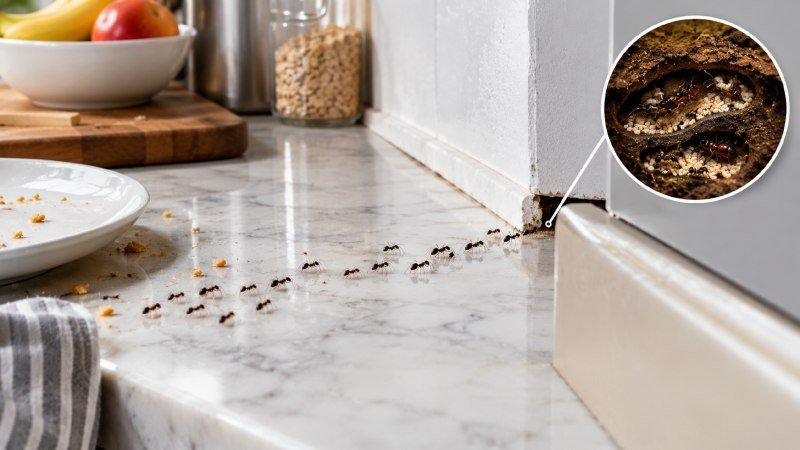
A line of ants crosses the kitchen counter, someone sprays them, and by afternoon the counter is clear. Two days later the trail is back, sometimes with more ants than before. The experience is so common that many people assume the spray was weak or the ants were unusually stubborn. The truth is simpler. What walks across a counter is a tiny portion of a much larger group, and most of that group never leaves the nest. Quick fixes remove what is visible. Lasting results depend on understanding what stays hidden.
Why the Ants You See Are a Small Part of the Colony
An ant colony is organized around a queen, or in some species several queens, who lay eggs inside the nest. Workers handle everything else: foraging, feeding larvae, digging, and defending. Only a fraction of those workers are out searching for food at any moment. The rest are tending young, moving eggs between chambers, or resting underground, behind walls, or inside other protected spaces.
That structure explains why a visible trail says little about colony size. Dozens of foragers can represent a population of thousands. Nests may sit outdoors in soil, under pavers, inside a rotting stump, or in a wall void, and some species keep several nests connected by trails. The workers seen indoors are the colony’s scouts and feeders, and when they die, others replace them. As long as the queen survives and the nest keeps producing workers, the supply of foragers continues. Removing the front line has almost no effect on the source.
What Quick Sprays and Surface Treatments Actually Remove
Over-the-counter sprays kill ants on contact, and the effect is satisfying because the problem seems to vanish. In reality, those products affect only the workers that were exposed. They do not reach the nest, the queen, or the larvae. Some repellent sprays make matters worse. A colony that senses danger along a trail may split, a behavior called budding in certain species, and the group then forms new nests in different places.
Searching for a fast answer such as can i get rid of ants overnight is understandable, since nobody wants a trail running through the pantry for days. Some steps do give immediate relief, such as wiping trails, cleaning crumbs, and sealing food. Yet real control usually takes longer, because it has to reach the part of the colony that lives out of sight. Wiping away ants, spraying a baseboard, and stopping there handles symptoms only. Expecting a single treatment to settle everything often leads to disappointment and repeated sprays.
How Ants Keep Entering Through Hidden Pathways
Even when visible activity seems to stop, ants may simply be using a different route. Homes have many concealed passages: gaps around plumbing under sinks, spaces behind cabinets, openings where electrical or cable lines pass through walls, cracks in baseboards, and seams between countertops and backsplashes. Ants travel inside wall voids and along pipes, appearing only where the structure lets them out.
A trail that disappears may have moved a few feet behind a surface. Activity that pauses after a spray may return when the residue fades or when a new scout finds the same opening again. Warm kitchens and bathrooms attract ants because of moisture and food residue, and laundry rooms, dishwashers, and refrigerator drip trays can supply water. Tracing where ants emerge, rather than where they gather, shows the real pathway. The most useful clue is usually the first point where an ant becomes visible, since that marks the entry gap.
Tracking Trails, Removing Food, and Cleaning Scent Paths
Before choosing any treatment, gather information. Careful observation tells more than a quick spray ever could. A practical approach looks like this:
- Watch the trail at different times of day and note where ants come from and where they go.
- Follow the line to the point where it enters the room, using a flashlight where needed.
- Photograph the entry point and any nearby moisture, crumbs, or sticky residue.
- Remove food sources by wiping counters, sealing sweets, and cleaning up spills and pet dishes.
- Clean trails with soapy water or a vinegar solution to break the scent path ants use.
- Seal obvious gaps with caulk once the trail has been identified and cleaned.
Cleaning scent paths matters because ants follow chemical markers laid down by earlier workers. Wiping a trail removes the guide and forces scouts to search again. Taking away food and water reduces the incentive to return. If trails keep reappearing despite this effort, the question changes from how to remove ants to where the colony lives, and that is the point where asking whether can I get rid of ants overnight is realistic gives way to planning a longer approach.
Identifying Recurring Entry Areas Before Choosing a Treatment
Patterns across weeks provide the clearest guidance. If ants keep arriving at the same window, the same cabinet, or the same corner of the garage, the colony likely has a stable route there. Moisture, nearby soil, or a vegetation bridge touching the wall often explains the choice. Outdoor walks help too, since nests along foundations, under patio slabs, or in mulch beds often connect to indoor activity.
Treatment choices should follow this information. Baits that workers carry back to the colony target the hidden population, while repellent sprays disrupt trails without reaching the nest. Different species respond to different baits, so identification matters, and applying the wrong product may waste time or cause the colony to move. Homeowners who understand the pathway can describe it clearly to a professional, who can then confirm species, find nests, and select a method suited to the property. Clear notes and photographs speed that process considerably and often prevent repeated visits.
Key Takeaways
Ants seen indoors represent only a fraction of the colony, and the rest depends on a nest that sprays and wipes never reach. Quick fixes can bring relief for hours or days, but they seldom solve the underlying source, and some can scatter a colony into new locations.
A more dependable approach starts with observation: where ants enter, what they feed on, which routes they follow, and how moisture or structure supports them. Cleaning scent trails, removing food, and sealing gaps reduce activity, while a plan aimed at the colony addresses the cause. When trails return despite careful effort, the nest is probably still active, and the useful next step is to identify it rather than to spray again.